
Most people have never seen a cider apple tree up close. At the Spreyton cellar door, you can walk right through a whole block of them.
The Cider Block is where we grow heritage cider apples from England and France, here on our family orchard in North West Tasmania. Signs along the rows tell the story of each variety, so you can wander at your own pace and learn as you go.
Here’s what you’ll find, and the ciders these apples end up in.
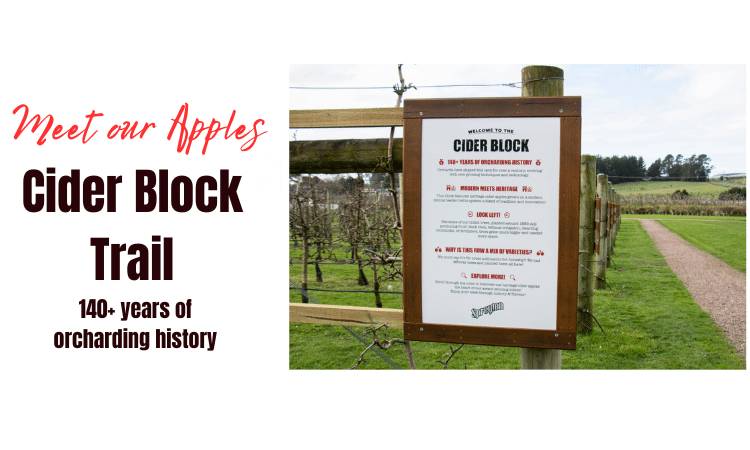
More than 140 years of orcharding
Orchards have shaped this land for more than 140 years. Our family has been part of that story since 1908, and we’re now five generations in.
A lot has changed in that time. New growing techniques and technology have transformed the way we look after our trees, and the Cider Block shows both sides of that story.
Old varieties, modern growing
The apples in the Cider Block are heritage varieties, but the trees are grown the modern way, on a central leader trellis. Each tree is trained up one main trunk, with a trellis to support it. It’s old apples and new know-how, side by side.
Our oldest trees, planted around 1890
Stand at the welcome sign, look left, and you’ll see some of our oldest trees. They were planted around 1890, and they’re still producing fruit.
Back then, growers had no irrigation, no fertilisers and no dwarfing rootstocks (the roots that keep modern trees small). So the trees grew much bigger and needed a lot more space. Standing beside them, you can see how far orcharding has come.
Why is one row a mix of varieties?
We’d love to say it’s for cross-pollination. Honestly? We had some leftover trees and planted them all in the one row.
A quick guide to cider apples
Cider apples aren’t like the apples in your fruit bowl. Most are too bitter, dry or sharp to enjoy fresh. What makes them special is what they bring to cider. Cider makers look at two things: tannin and acid.
- Tannin is the dry, slightly grippy feeling you get from strong black tea. It gives cider body.
- Acid gives cider freshness and a tangy bite.
Bittersweet apples are high in tannin and low in acid. Bittersharp apples have both. Most of the apples in the Cider Block fall into one of these two groups.
The bittersweet apples
Michelin
A traditional bittersweet from France that was introduced to England in the late 1800s. It makes a light, golden cider with a soft, tannic finish, and we blend it with sharper Tasmanian varieties.
Britchel
A rare English bittersweet with plenty of tannin and rich, earthy flavours. It was traditionally a favourite for ciders that were aged for a long time, and it’s one of the apples in our Classic Dry.
Somerset Redstreak
A West Country bittersweet with lots of natural sugar and gentler tannin. It became one of the most widely planted cider apples in England, thanks to its high juice yield.
Bulmer’s Norman
Originally from Normandy in France and widely grown in Herefordshire. Its deep tannins give cider real structure, and you’ll find it in both our Classic Dry and our Apple Cider.
Yarlington Mill
A Somerset apple that was found growing by chance near a watermill in the 19th century. It brings natural sweetness and a hint of spice, and it works in a single varietal cider or a blend.
The bittersharp apples
Kingston Black
One of the most famous cider apples in the world, from Somerset in England. It’s one of the few apples that can make a well-balanced cider on its own, which is exactly what we do with it in The King.
Breakwell’s Seedling
A historic Herefordshire cider apple from the late 19th century, with a striking red flush. It’s one of the earliest cider apples to ripen, so cider makers can start pressing before the main harvest.
A French curiosity: Bec d’Oie
Bec d’Oie (say “bek dwah”) means “goose beak” in French, named for the apple’s tall, pointed shape. It’s a traditional French variety, and we blend it into ciders with a soft, velvety feel.
Taste the Cider Block in your glass
These apples are the heart of our award-winning ciders. Here’s where to find a few of them.
- Classic Dry: Britchel and Bulmer’s Norman, with Gravenstein.
- Apple Cider: Bulmer’s Norman and Kingston Black, with Dabinett and some eating apples.
- The King: our Kingston Black cider, made with minimal blending so the apple shines.
After your walk, order a tasting paddle and see if you can pick the apples you’ve just met.
Plan your visit to the Spreyton cellar door
The Spreyton cellar door is at 6 Melrose Road, Spreyton, on our family’s Tasmanian apple orchard. It’s about 15 minutes from Devonport and the Spirit of Tasmania, so it’s an easy stop when you get off the ferry or before you board. It’s also on the way to Cradle Mountain.
You can walk the Cider Block at your own pace. Make a day of it with a meal at the Orchard Kitchen, while the kids try our juices and run around the playground. Travelling by caravan? Parking is easy for day visits.
Visit Spreyton Cider Co
Come and experience Spreyton for yourself. Enjoy seasonal Tasmanian food, cider tasting paddles, craft beer, spirits, non-alcoholic drinks, sparkling water and fresh apple juice beside our working family orchard.
Spreyton Cider Co is located at 6 Melrose Road, Aberdeen, Tasmania 7310. Only 10 minutes from Devonport or Latrobe.
Cellar door: Open daily from 10.00 am to 5.00 pm and until 8.00pm on Friday nights
Kitchen: Lunch daily from 11.30 am to 3.30 pm and Friday dining from 11.30 am to 7.00 pm
Contact: Call us on (03) 6427 3664 or visit the website: spreytonciderco.com.au or email hello@spreytonciderco.com.au
Plan your visit, book a table or shop the Spreyton range online.